


Marijuana Detection Times: How Long THC Stays in Your System

One smoke session may be over in a few hours, but your body keeps the receipts much longer. Weed can remain detectable from several hours to several weeks, depending on the drug test, your frequency of use, dose, metabolism, and body composition.
In this guide you will learn how long thc remains detectable in your body, how THC moves through your body and some detox tips so keep reading.
How Long Does Marijuana Show Up in Different Drug Tests?
Government agencies, employers, police, and sports officials, among others, can choose from various methods and devices to test for marijuana use. Each method has its own unique window of detection.
Here is a general weed detection time for the most common drug tests:
-
Urine test - 3-30 days
-
Blood test- 24-48 hours
-
Saliva test- 24 or 72 hours
-
Hair test-Up to 90 days
-
Sweat test- 7 to 14 days
URINE TEST
Urine testing, also called urinalysis or UA testing is the most common way to screen for marijuana use. Urine samples are relatively easy to collect, inexpensive to process, and less invasive than blood samples.
Most urine tests do not look for active THC. Instead, they detect THC-COOH, also called carboxy-THC, a non intoxicating metabolite produced after the liver breaks down tetrahydrocannabinol(THC).
Because THC-COOH can remain in the body after the short term effects are gone, a person may feel completely sober and still test positive.
According to National Drug Court Institute guidance, THC can stay in the urine for:
-
Single use or occasional use: roughly 1 to 3 days, though it can be longer
-
Moderate use: several days to around two weeks
-
Regular use: two to four weeks or more
-
Daily or chronic use: 30 days or longer in some cases
BLOOD TEST
Blood tests are more invasive because they require a blood draw. For that reason, they are less common in routine workplace drug screening.
They are more likely to be used after a crash, during an impaired driving investigation, in a medical setting, or when authorities are trying to determine whether cannabis was used recently.
Unlike urine testing, blood testing may detect active THC as well as THC metabolites because after smoking or vaping, THC enters the bloodstream within minutes.
-
For occasional users, active THC may remain detectable in the blood for several hours and sometimes 1 or 2 days.
-
Regular users may have detectable blood levels for longer because stored cannabinoids can gradually move back into circulation.
SALIVA TEST
Saliva tests, also called oral fluid or mouth swab tests, are convenient, observed, and relatively difficult to tamper with. They are used for roadside programs, workplace testing, and situations focused on recent cannabis exposure.
Because THC can remain in the mouth after smoking or vaping, saliva samples may produce a positive result within hours of use. The usual detection window is around 24 to 48 hours, though regular users may test positive for up to 72 hours or longer.
HAIR TEST
Hair testing offers the longest routine lookback period to marijuana usage - about 90 days. Following cannabis consumption, drug compounds may reach growing hair through blood vessels around the follicle and become incorporated into the hair shaft.
A laboratory generally analyzes a small segment close to the scalp and since scalp hair grows at an average rate - the length tested creates a rough historical window.
Hair tests are more expensive and less useful for detecting very recent use. They are also better at identifying repeated exposure than one small, isolated dose.
SWEAT TEST
Sweat testing uses an adhesive patch that is applied to the skin. The patch may remain in place for up to one or two weeks, collecting substances released through sweat during that period.
Sweat pactches may be used in treatment programs, employment monitoring, probation, or the criminal justice system because it collects information over several days rather than from one moment.
-
A sweat patch may detect cannabis exposure that occurs while the patch is being worn, commonly over 7 to 14 days.
AT HOME DRUG TESTS
At-home marijuana tests are easy to find online and in many drugstores. Most are urine tests that screen for THC-COOH so the detection time is similar to what we have covered in the urine test section.
At home kits can provide a rough indication of whether your metabolite level is above the kit’s cutoff, but they are not as reliable as confirmed laboratory testing.
An expired test, poor storage, damaged chemicals, incorrect timing, user error, or overly diluted urine may lead to an invalid result or false positive/negative. Check the expiration date, follow every instruction, and remember that one home result does not guarantee the same outcome in a workplace or court ordered test.
THC Metabolism: How Your Body Breaks Down THC
To understand why marijuana remains detectable, it helps to follow what happens after THC enters your body.
When you smoke or vape cannabis, THC passes through the lungs and enters the bloodstream quickly. It reaches the brain within minutes, which is why the effects usually begin much faster than they do with edibles.
Once it enters circulation, THC moves throughout the body. Some reaches the brain and produces the familiar psychoactive effects. Some is distributed to organs, while some moves into fatty tissues.
THC is fat-soluble. That means it can be stored in fat cells rather than remaining only in blood and other water based fluids.
The liver then begins breaking THC down. It first converts some THC into 11-OH-THC, an active metabolite that can also produce psychoactive effects. That compound is processed further into THC-COOH, the metabolite most urine drug tests are designed to detect.
Edibles follow a different route.
After you eat an edible, THC travels through the stomach and intestines before reaching the liver. This process is called first-pass metabolism. During this trip through the liver, more THC may be converted into 11-OH-THC before entering the wider bloodstream.
That helps explain why edibles can feel stronger, take longer to kick in, and last longer than smoked or vaped cannabis. For a closer comparison, read our guide to edibles versus smoking weed.
Eventually THC metabolites leave the body mainly through feces and urine but because THC can be stored in fatty tissues and released gradually, regular users may continue producing detectable metabolites long after their last session.
And now that you know how THC is processed in your body, the next question is obvious: why does one person test negative after several days while another remains positive for several weeks?
![]()
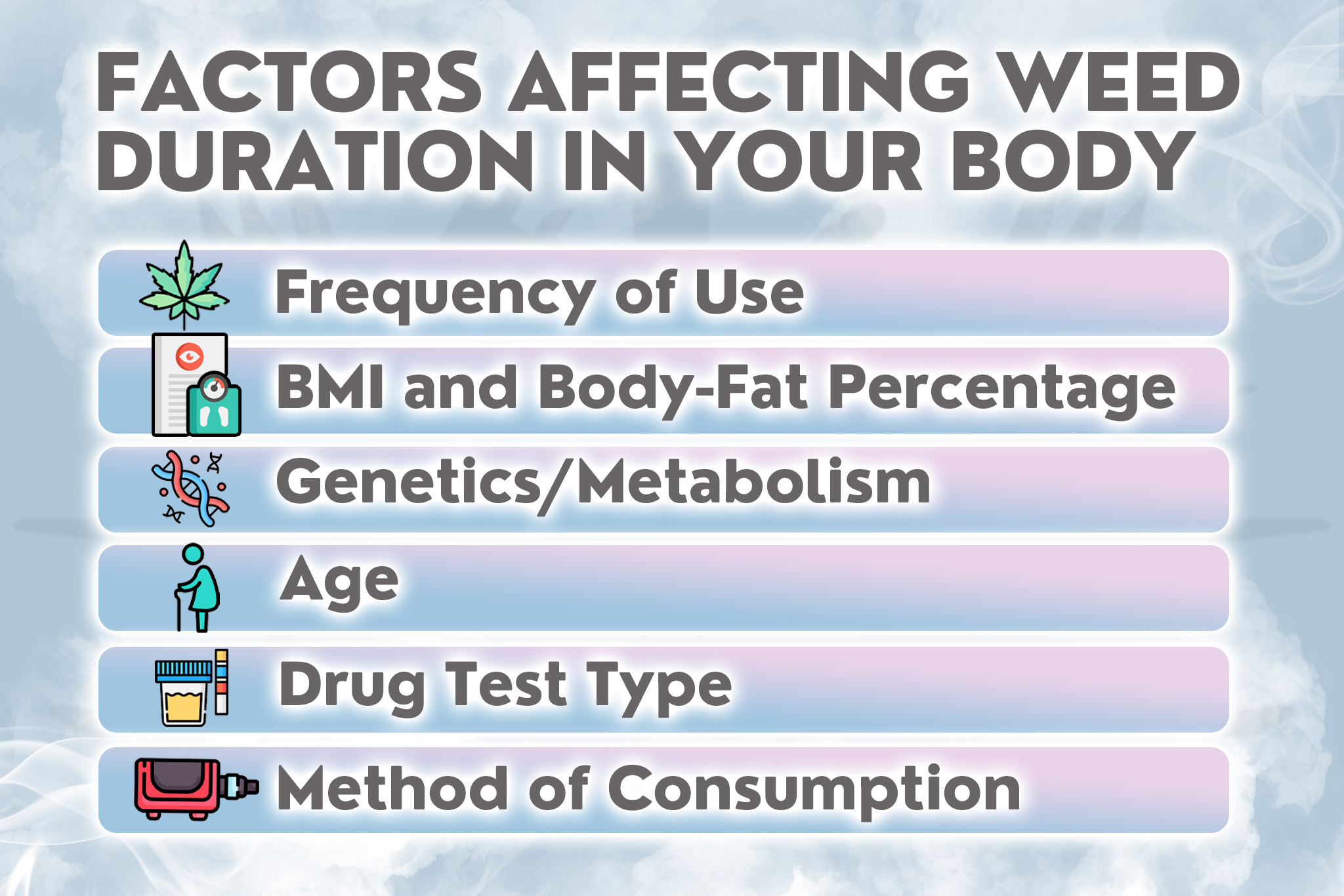
![]() What Factors Affect How Long Marijuana Stays in Your Body?
What Factors Affect How Long Marijuana Stays in Your Body?
Frequency of Use
Someone who takes a couple of puffs once may clear THC metabolites much faster than someone who uses cannabis every evening. With repeated use, new THC enters the body before metabolites from the previous session have fully cleared.
BMI and Body-Fat Percentage
Because THC is fat-soluble ,someone with a higher body-fat percentage may retain THC compounds for a longer time than someone with less body fat.
Genetics/Metabolism
Your genes can affect the liver enzymes responsible for breaking down THC.
Some people process cannabinoids faster than others. Metabolic rate, liver health, kidney function, medications, hormones, diet, and overall health may also influence how quickly THC metabolites leave the body.
Age
Metabolism, liver function, kidney function, and body composition can change with age which is why older adults may process thc more slowly than a younger person.
Test Type
As you have seen in an earlier section of this article, blood and saliva tests usually have shorter detection windows while Urine testing and hair tests can detect thc for much longer.
Method of Consumption
Smoking and vaping deliver THC quickly. Edibles take longer to begin working because they pass through digestion and the liver, while concentrates can deliver a much larger dose in one session. The higher the amount of THC entering your system, the longer it may take to fall below a test’s cutoff.
Can You Flush THC Metabolites Out of Your System Faster?
Knowing the basics of how long marijuana stays in your body and the types of tests is one thing, but you may be most concerned about eliminating thc quickly from your system prior to a drug test.
And so goes the question: can you speed up the process?
The honest answer is not by much.
Time and abstinence are the only dependable ways to reduce the amount of THC and THC-COOH in your body. Detox kits, extreme hydration, intense workouts, and other last-minute tricks cannot guarantee a negative result.
Does Hydration Help Eliminate THC?
Normal hydration helps your kidneys function, but water does not pull THC out of fat cells on command.
Drinking a huge amount of water before a urine test may dilute the sample. Modern testing can check markers such as creatinine and specific gravity to identify urine that is unusually diluted.
Instead of receiving a negative result, you may be asked to test again. In legal, probation, or workplace settings, a diluted sample may also raise suspicion.
Overhydration can be risky, so drink according to your normal thirst, activity level, climate, and medical needs.
Will Exercise Help?
Regular physical activity supports general health and metabolism, but it is not a guaranteed shortcut.
Because THC can be stored in fat cells, intense exercise may temporarily release stored cannabinoids into the bloodstream. That means a hard workout right before a test could potentially work against you rather than help.
What About Detox Drinks and Kits?
Detox drinks, pills, shampoos, vinegar mixtures, and similar products often promise more than they can prove.
Some products simply encourage you to drink large amounts of fluid, which may dilute urine temporarily. Others contain vitamins or coloring agents designed to make diluted urine look more normal. None of this means THC has actually been removed from fatty tissues.
At-home detox products are also different from medical detox. Medical detox involves professional support for someone experiencing substance dependence, marijuana addiction, withdrawal symptoms, or other health concerns.
Bottom Line: Give Your Body Time
If you are trying to pass a drug test our advice would be: now that you are well educated on how long weed stays in your system, plan your usage well if you must and give your body enough time to process and remove the remaining metabolites naturally.
Stay safe and stay healthy with a Mooselabs filter!
FAQ:
I only took a couple of puffs, how long will the thc stay in my system
If you only took a couple of puffs, active THC leaves your bloodstream within 1 to 2 days.
How long does it take for the effects of cannabis to wear off?
1 to 4 hours if you smoke or vaped weed and 4 to 8 hours if you ingested a cannabis edible
Will I fail a drug test if I smoke once a week?
Yes you can fail a drug test even if you smoke once a week but it will depend on the type of test and the abstinence period from the last time you smoked.
A 2026 systematic review also found that even low THC doses sometimes exceeded workplace urine-testing thresholds, while weekly to daily users could remain above certain thresholds for weeks.
Do edibles show up in drug tests?
Yes, THC edibles do show up on standard drug tests because your liver processes ingested THC into the same metabolites (like THC-COOH) that tests target.
Can secondhand marijuana smoke cause a failed drug test?
It’s possible and some studies have show that marijuana was present in urine samples of individuals who were exposed to secondhand smoke.
Similar Blogs:


SPECIAL FOR OUR BLOG READERS!
CLAIM YOUR
As a valued reader, you deserve more than just great content.
Enjoy 20% off your next tech purchase as our way of saying thanks for sticking with us.
Use Code